
Something feels off
Questions I Ask When Everything Looks Right But Feels Wrong
Your business works, and something still feels off. Five questions to tell whether the decision is actually yours, before you add another tool to fix it.
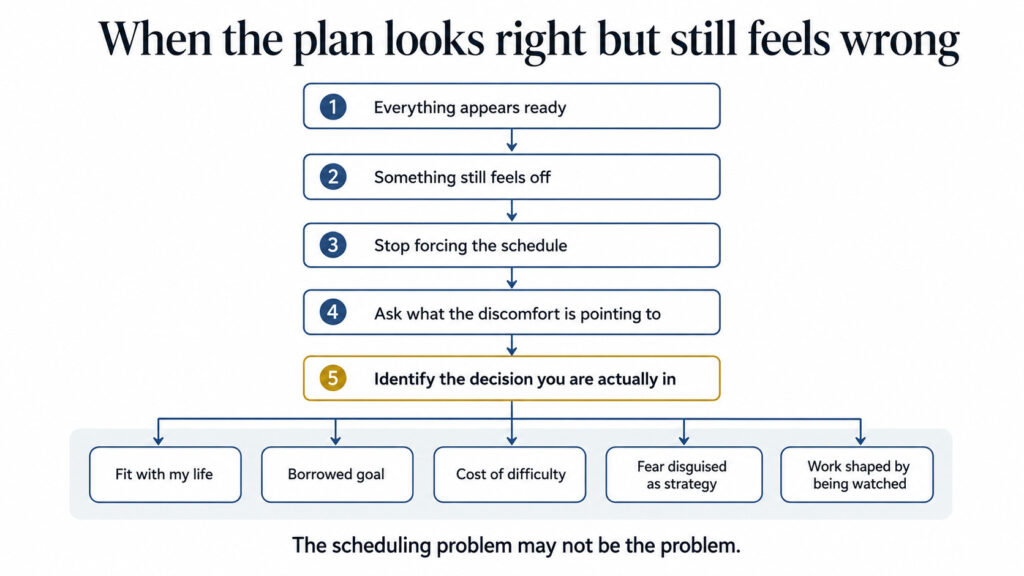
There was a website launch sitting on my calendar, and a product reveal to go with it. Both had been moved more than once. Nothing about the plan was wrong. The pages were built. The dates were picked. The work was there waiting for me to go do it.
And I felt nothing. Not nervous, not overwhelmed. Flat.
So I stopped and asked myself why I was forcing this into my schedule.
That question did not hand me the push to finally get it done. It did something more useful. It showed me that forcing the schedule was never the problem I needed to solve.
The advice I did not understand for years
When I was first starting my business, a mentor told me something that took me a long time to hear correctly.
Your best decisions come when you’re comfortable enough to sit with yourself and be alone in the decision.
I heard it as advice about confidence. Be braver. Ask yourself the hard stuff. That is not what they meant.
They were not telling me to stop asking people for help, or to ignore strategy, or to work in isolation. They were saying that sometimes you have to quiet the outside noise long enough to hear the inside noise. The part of you that already knows something is off and has not been given a chance to say why.
That is the part that gets drowned out first.
The problem with more
When something feels off, almost every answer you get is more.
- More strategy
- Another tool
- A better prompt
- One more skill to pick up
- Somebody’s playbook, because it worked for them, so it should work for you
I am not against any of that. I build with these tools. I use AI every day and I think most of it is genuinely good. But more only helps when you already know what you are building toward. When you don’t, more just gives you a bigger pile of things you didn’t want.
That is the actual work here, and it comes before the technology, not after it. If you cannot say why you are doing something, no automation is going to fix it. It will just help you do the wrong thing faster and with better formatting.
The questions below are the ones I use to figure out whether a decision is mine or borrowed.
One thing before you start. If you read one of these and come up blank, that is not a failure and it does not mean you skip it. A blank is information. Usually it means the answer is one you have been avoiding, or the decision was never yours in the first place and there is nothing in there to find. Either one is worth knowing.
1. Does this fit the way I want to live and work?
Not: is this a good opportunity. Not: is this a smart move. Does it fit the actual shape of your life.
This is the one people skip because it sounds soft. It is not soft. It is the one that catches the thing that will still be true in eight months, when the enthusiasm is gone and you are stuck maintaining whatever you agreed to.
Skipping it sounds like I’ll figure out the schedule later. You will not figure out the schedule later. The schedule is the decision.
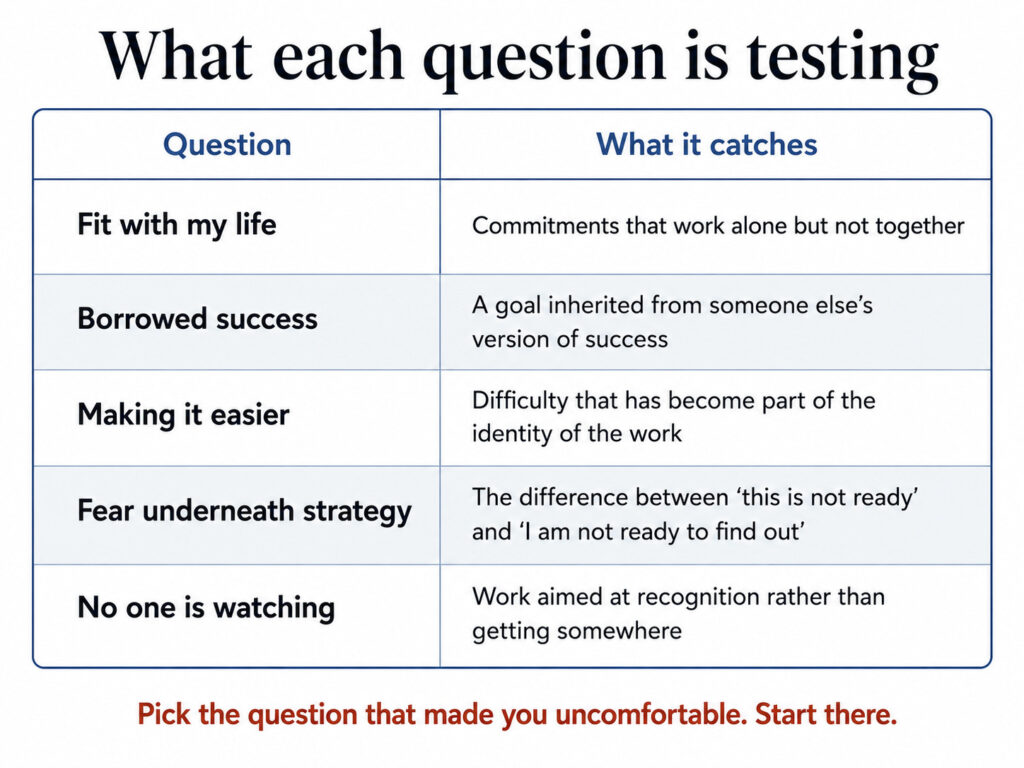
What it catches: commitments that are fine in isolation and wrong in combination. A workflow that requires you to be present every day when the whole reason you built it was to not be. A launch cadence that assumes a version of you who does not get tired.
If you come up blank on this one, try it backwards. Describe a week you would not want. It is usually easier to name what you are protecting yourself from than what you are moving toward.
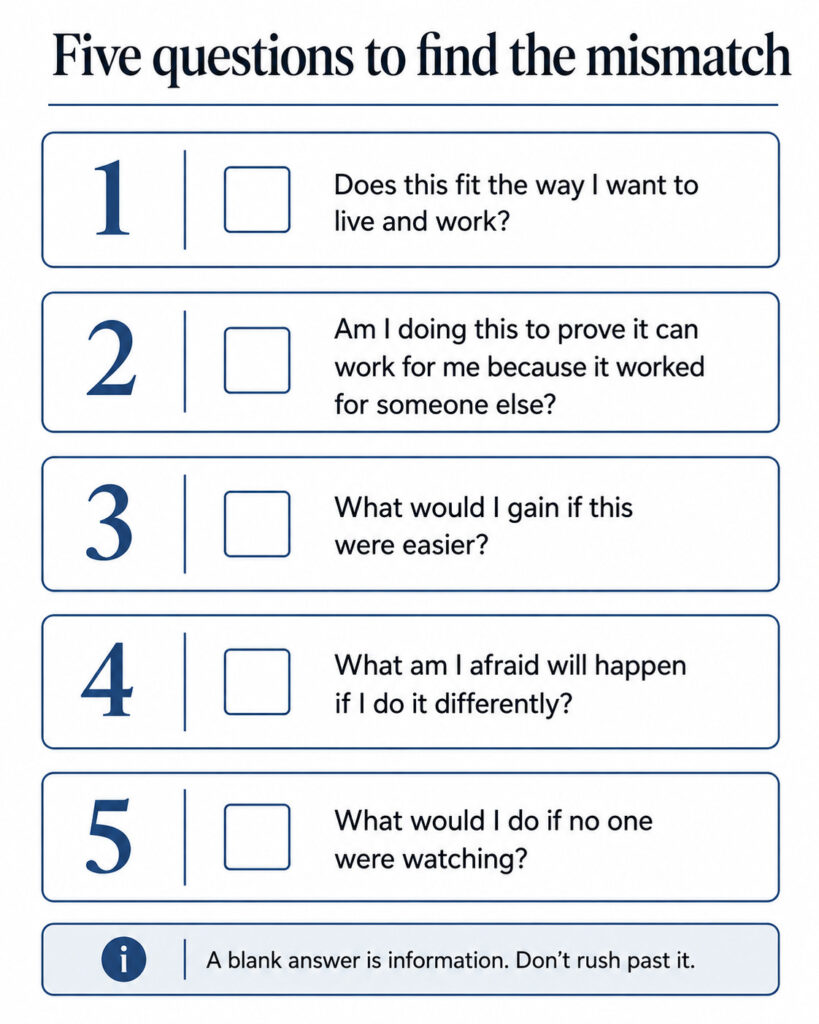
2. Am I doing this to prove it can work for me because it worked for someone else?
Someone you respect did the thing and it worked. Now you want to run it, partly because it might work, and partly because you want to be the kind of person it works for.
Those are two different motives and they feel identical from the inside.
The second one is expensive. It has you building somebody else’s business inside your own, and it does not announce itself. It shows up as a system that technically functions and that you quietly resent.
What it catches: borrowed goals. This is also where the goal question really lives. People ask themselves what’s the actual goal here and get a clean-sounding answer, because the goal was never the confusing part. Alignment was. The goal is easy to state and easy to inherit without noticing.
The tell: if it works but nobody ever finds out you did it, does it still feel worth it? If the answer wobbles, some of the reason you are doing it is the finding out.
3. What would I gain if this were easier?
We have been taught that easy means lazy, or that if it was not hard you must have cut a corner. That is not what this asks.
It asks what you would get back. Time, attention, patience, the willingness to actually keep doing the thing.
Notice the framing. Not what would this look like if it were easier, which is a design question. What would you gain, which is a cost question. Difficulty is a cost you are paying, whether or not you have priced it.
What it catches: struggle that has become part of your identity. Processes you keep because you built them, not because they work. The five-step version of something that has a two-step version, kept because the five steps feel more legitimate.
Blank answer here usually means you have never let yourself imagine the easier version in enough detail to want it. So build it out. What would you actually do with the hours.
4. What am I afraid will happen if I do it differently?
This is the one that finds fear where you have been calling it strategy.
A lot of decisions that look like careful planning are avoidance wearing a nice outfit. Holding a launch because the timing is not perfect. Adding another round of review. Building one more piece before you show anyone. Each of those has a reasonable-sounding justification, and sometimes the justification is even correct.
But you have to check.
What it catches: the difference between this is not ready and I am not ready to find out. Those produce identical behavior and completely different outcomes.
Name the specific fear, not the category. Not “failure.” That it flops and the people who watched me build it see it flop. That I find out I was wrong about something I have been saying publicly for two years. That nobody cares and I have to sit with that. Specific fears can be evaluated. “Failure” cannot.
5. What would I do if no one were watching?
This one absorbed another question I used to ask separately, about who I was trying to be with a choice. Thought leader, teacher, educator, creator, expert. All of those are answers to the same thing: who is watching, and what am I hoping they conclude about me.
So the cleaner version is the original. Strip out the audience and see what is left.
Sometimes the answer is that I would still do it, exactly the same way, because I am curious and I want to know what happens. That is a good sign. Some of my best work started as something nobody asked for and nobody would have understood if I had explained it at the time.
Sometimes the answer is that I would not do it at all. That is worth knowing before you spend three weeks on it.
What it catches: work aimed at accolades rather than at getting somewhere. Both feel productive. Only one of them compounds.
Back to the launch
I would love to tell you that I asked myself these questions, had a clean realization, and the calendar sorted itself out. That is not what happened. What happened is that I stopped treating the scheduling problem as the problem, which is a smaller and much less satisfying result.
But it was the right size. The questions do not produce a decision on demand. They tell you which decision you are actually in, which is usually not the one on your calendar.
That is the whole thing. When everything looks right and something still feels wrong, the mismatch is rarely in the plan. It is between the plan and the person running it. No tool finds that for you. It is quieter than that, and it takes being willing to be alone in it for a minute.
Pick the one of these that made you uncomfortable. That is the one.