
Something feels off
What to Automate and What to Keep Manual in a System You Built Yourself
Two systems I built worked exactly as designed and still lost something. Here is the test I use now for what to automate and what to keep manual.
I have an email sorter that runs every four hours. It reads what came in, drops each thread into a label, archives it, and never asks me a single question. It is accurate. I tested it against real mail and it filed every thread where it belonged.
And for a stretch there, I still could not have told you what was actually in my inbox.
The deadline-driven items got their own label and pushed to a list in Notion. The list worked exactly the way a list works. Things went onto it. Things stayed on it. Some of them for weeks. A back-and-forth thread would turn into three entries that were really one conversation, and eventually I stopped being able to read what the list was telling me. It started to feel like a productivity thing rather than help.
Meanwhile I was opening my email and sorting it in my head anyway.
That is the part I keep coming back to, because I have now watched the same thing happen twice, in two systems that have nothing to do with each other.
The short answer
If you built a process for yourself and something about it feels off even though it is doing its job, go looking for the step where you used to be deciding something.
Smooth the mechanical parts. Keep the parts where you were making a judgment call.
Mechanical steps are the ones with a right answer you would give the same way every time. Moving a thing from here to there. Formatting. Sorting. Remembering. Those are safe to automate, template, or hand off, and you will not miss them.
Deciding steps are the ones where you looked at what was actually in front of you and chose. Those are the ones that quietly disappear, because they do not look like steps. They look like time.
A process can remove every one of them and still pass its own test, because the output stays correct. What changes is that you are no longer in it.
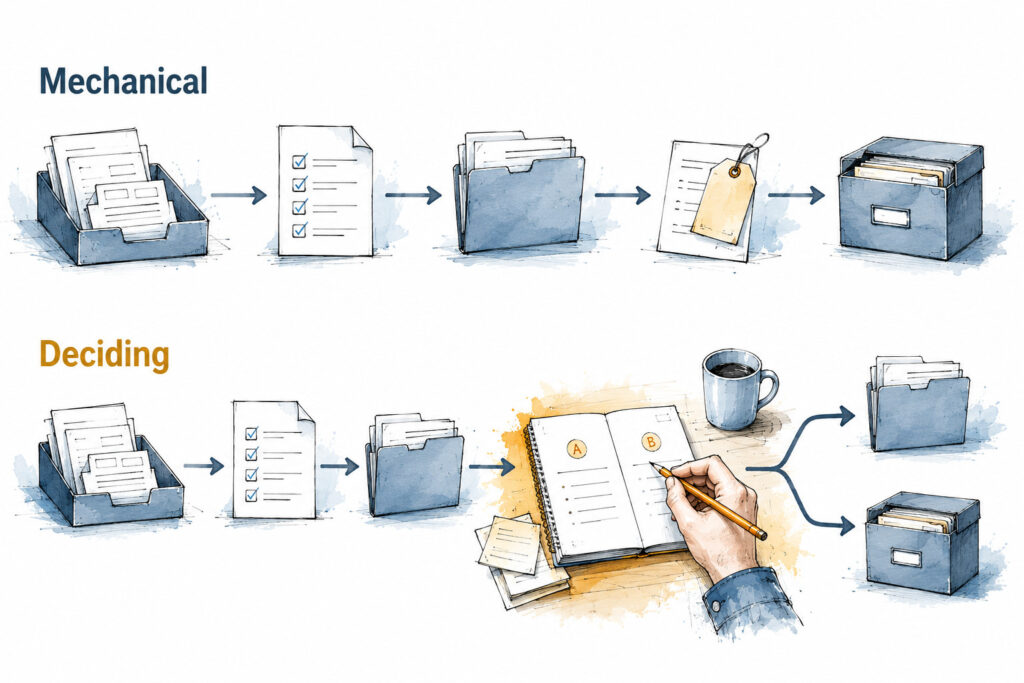
What my sorter actually removed
The sorter did not break. It did what I asked it to do.
What I had not noticed was that opening my own mail was doing two jobs, not one. Filing, and noticing. I automated the filing and lost the noticing along with it, because the noticing was never a step anybody had written down. It was just what happened while I was filing.
Then the Notion list made it worse in a way that looked like an improvement. It gave the deadline items somewhere official to go. Somewhere official to go is not the same as somewhere that gets decided.
So the list is retired. The sorter still runs, still sorts, still archives, and I have no complaints about that part, because sorting is mechanical and it is good at it. What I added back is a morning brief organized by attention instead of by folder. Dated items. Replies I owe. What I am waiting on. What is aging. It is the noticing, put back as its own thing, instead of expecting it to ride along with the filing.
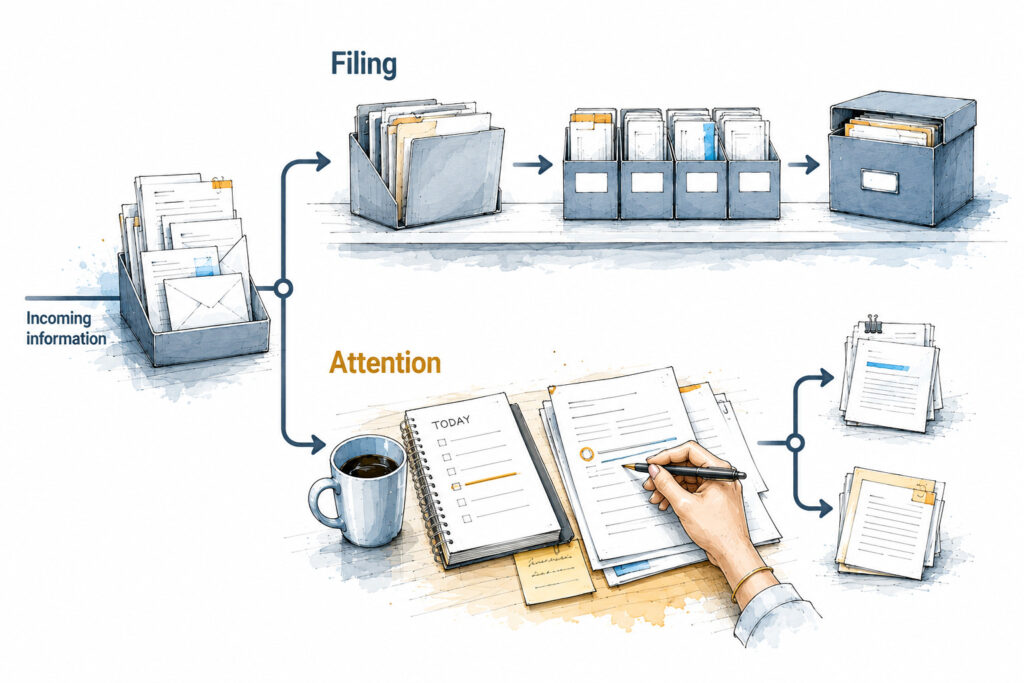
I will be straight with you that this is still in motion. The brief is new. I do not yet know whether it holds up over a month of real mail or whether I am about to find the next version of the same problem.
But I do know the level of frustration. Opening Notion and the same four items are sitting there, some touched several times. On paper it looked fine, but the reality is what I wanted and what it interpreted were two completely different things.
The same failure in a completely different system
The other place this showed up was writing.
The Content Lab is my multi-step process for working with AI on articles. It was never meant to replace me. It was built to work with me, and over time I added guardrails to each phase. Give the story a real beginning and end instead of letting it trail off. Add something actionable when the piece calls for it. Stop me from overthinking a decision I had already made. Keep me from repeating myself once I had made the case.
Every one of those reasons still holds. I was fixing real weaknesses of mine.
Then I went and looked at the numbers. Compared to a stretch in the spring, views were down about 25 percent. Open rate had dropped to 18 to 20 percent, against 24 to 25 percent in March and April. And the strongest posts in the batch were not the polished ones. They were the practical, work-driven pieces about things I had actually built, messy middle parts included.
Those numbers do not prove much on their own. New subscribers can pull an average open rate down without anybody disengaging. Topic and timing do their own work. But it was enough to stop me from explaining the feeling away.
What I found when I reread the older pieces next to the newer ones was that the newer ones kept the conclusion. They just did not keep the walk to get there. As I put it at the time: the relationship between me showing the whole process and you watching it happen was what was being edited out.
Same shape as the email. The guardrails kept the conclusion and dropped the thinking. The sorter kept the categorization and dropped the noticing. Both systems were correct. Both had removed the place where I was deciding.
How to tell the two apart
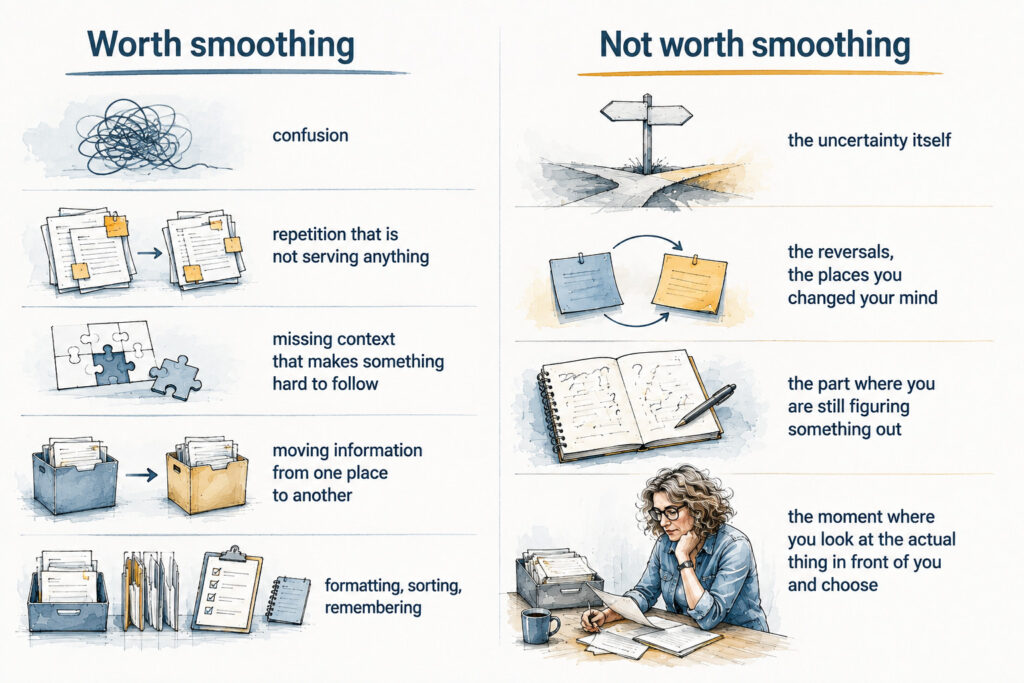
Worth smoothing:
- confusion
- repetition that is not serving anything
- missing context that makes something hard to follow
- moving information from one place to another
- formatting, sorting, remembering
Not worth smoothing:
- the uncertainty itself
- the reversals, the places you changed your mind
- the part where you are still figuring something out
- the moment where you look at the actual thing in front of you and choose
Before you smooth a step, ask whether that step is where you were deciding something. If it is, do not remove it. You can move it, speed it up, give it a better input. But keep a place where you are the one looking.
And do not treat a working system as evidence that nothing is wrong. Both of mine worked. That is what made them hard to catch.
What this does not tell you
I do not have a clean name for the line between those two lists, and I am not sure I want one yet. Naming it too early is how you end up with a rule that flattens the exact thing you were trying to protect.
I also do not know how much of what I saw in the numbers is really about any of this. Both systems are still open. The email brief is a week old. The Content Lab is something I am walking back through phase by phase, and I have not landed on which guardrail is responsible, or whether the guardrails are even the problem.
What I have is a better question to ask, which is more than I had a month ago.
If you want to check your own
Pick one system you built for yourself. Not the whole stack. One.
Walk through the steps and mark the ones where you used to making a call. Then check whether that call is still happening somewhere, or whether it got smoothed into a folder, a label, a template, or a list that nobody reads.
If your gut has been telling you something is off and you want somewhere to start, this is roughly how I started:
Something in my gut has been telling me [this part of my work] is off, and now I've got some numbers or evidence that back that feeling up: [describe what you found]. I don't want to tear the whole thing down. Where would you start figuring out what's actually going on?What did your process improve, and what did it quietly take out?